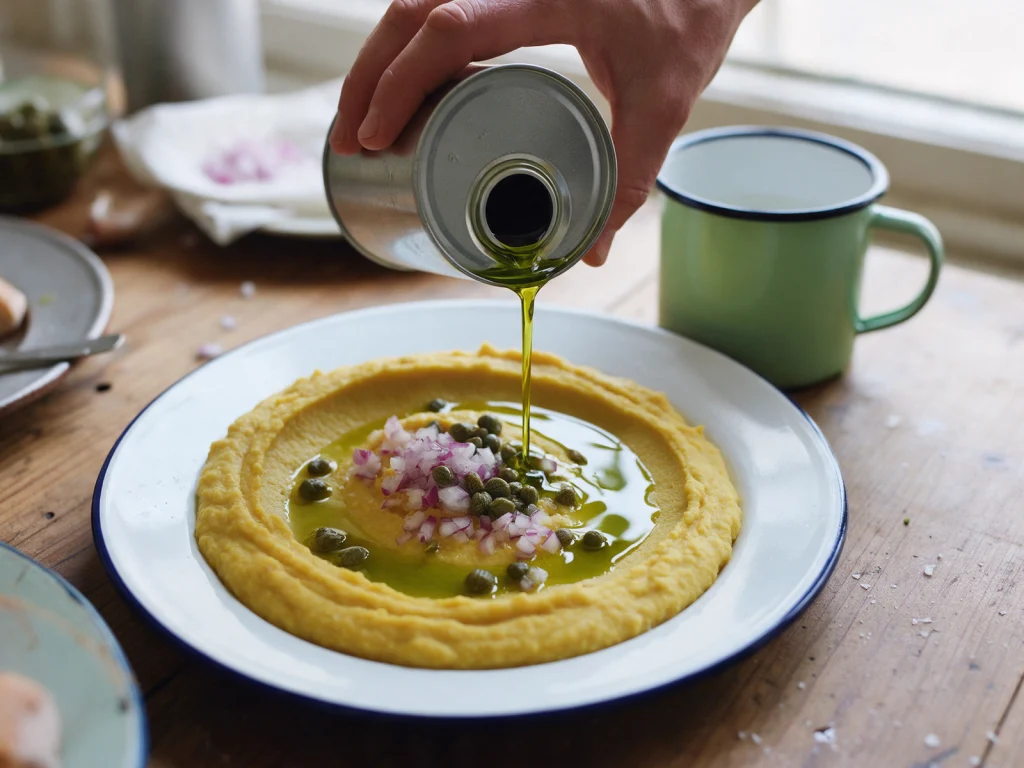
Fava with olive oil
Φάβα
The smooth yellow split pea purée served across Greece with onion, capers and raw olive oil. Serves 4 in about 1 hour 10 minutes. Not Santorini fava.
- Serves
- 4
- Preparation
- 10 min
- Cooking
- 1 h
Fava is the smooth yellow purée served across Greece with raw onion, capers and a generous pour of olive oil. The famous one is from Santorini. We do not sell Santorini fava, and this recipe does not need it: any yellow split peas make a fine fava at home.
A note on the name
In Greek kitchens fava means the dish, not the broad bean. Fava Santorinis is an EU Protected Designation of Origin for dried split seeds of Lathyrus clymenum, a different legume from the split pea, registered for Santorini. It has its own sweeter, earthier taste. PINAX does not stock it, because our range deliberately leaves out the summer islands.
What most Greek households cook day to day is made from yellow split peas (Pisum sativum), sold in any supermarket. That is what this recipe uses, and we say so plainly. The olive oil is where our shop comes in.
Method
- Rinse the split peas in a sieve until the water runs clear. Pick out any small stones.
- Put the peas in a heavy pan with the water, the roughly chopped onion, the garlic clove and the bay leaf. Bring to the boil.
- For the first 10 minutes, skim off the grey foam that rises to the surface with a spoon. Then lower the heat, half cover and simmer for 45 to 60 minutes, stirring now and then so nothing sticks. Add a little hot water if it becomes too thick before the peas are completely soft.
- When the peas have collapsed into a thick porridge, remove the bay leaf. Add the salt and 4 tablespoons of the olive oil.
- Blend with a stick blender until very smooth. It thickens as it cools, so stop while it is still slightly looser than you want to serve it.
- Stir in the lemon juice and taste. Adjust salt and lemon.
- Spread onto a wide plate while warm, make a hollow with the back of a spoon, and pour in the remaining olive oil. Top with the finely sliced red onion and the capers.
Notes
- Serve it warm or at room temperature, never fridge-cold. Leftovers loosen with a spoonful of hot water.
- Oil. Fava is one of the few dishes where you taste the raw oil clearly. A harvest-dated PDO oil is worth using here.
- Fasting. Fava contains no animal products and is a standard dish on Orthodox fasting days, including Clean Monday.
From the shop
Kolymvari Chanion Kritis PDO and Kalamata PDO extra virgin olive oils, each in a harvest-dated 500 ml tin. Both are marked Being verified until their bottlers are signed. The split peas, onion, capers and lemon come from any grocer.