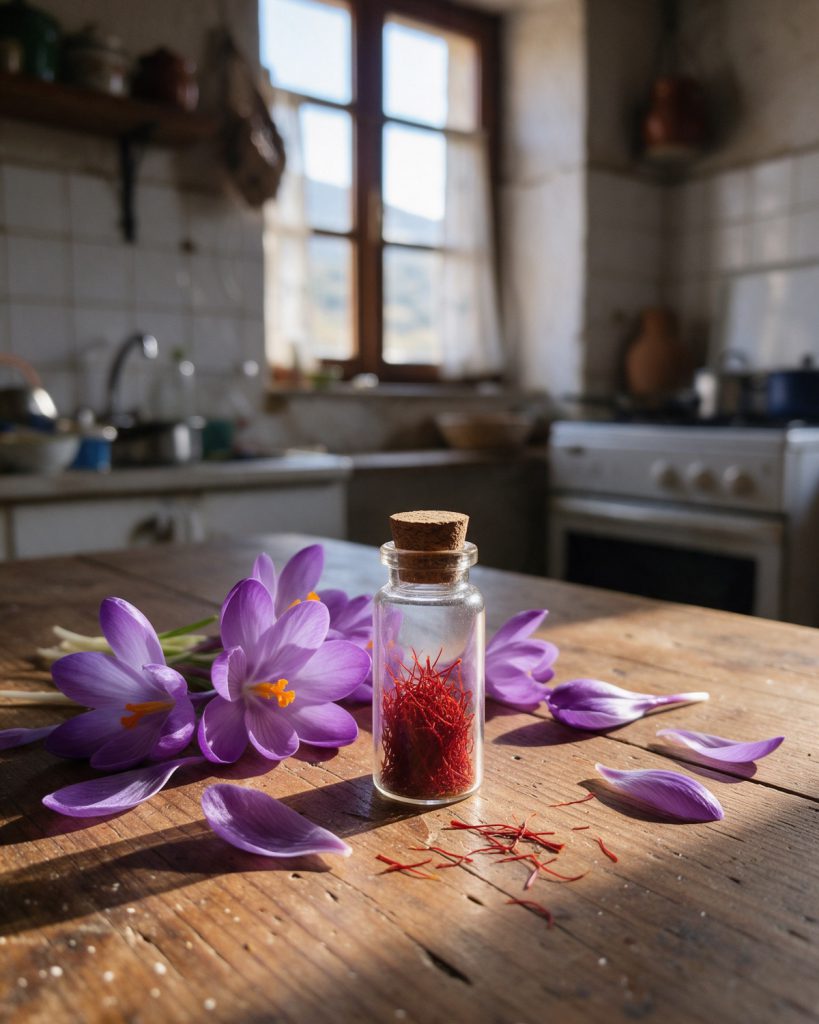
Saffron is the dried stigma of Crocus sativus. It is expensive because it is picked by hand, and anything expensive by the gram attracts fillers. The water test below is a kitchen screening test. It catches crude fakes. It does not prove that saffron is pure, and it cannot tell you where it grew.
Why saffron gets faked
In Kozani, where a single producers’ cooperative has held the exclusive right to harvest, sort, pack and sell Krokos Kozanis PDO since 1971, published figures put the yield at about 150,000 flowers for one kilogram of dried saffron. Each flower gives three red stigmas, separated by hand in the days after picking. Greek retail for the PDO product runs at roughly EUR 6 to 10 per gram.
In 2021 the European Commission published the largest coordinated check so far on herbs and spices sold in the EU: 1,885 samples tested across 21 Member States, Switzerland and Norway, with analysis by the Joint Research Centre. 16 of the 141 saffron samples, 11%, were flagged as suspicious. Four consisted mainly of safflower and one of marigold. Eleven more contained no foreign plant material but did contain dyes that are not authorised in food, among them Tartrazine and Sunset Yellow. Samples bought at local markets and online had much higher rates than those taken from importers and packers. That is a sample of the market, not a verdict on every jar, but it is a useful order of magnitude.
What the fillers are
The substitutes documented by food-fraud analysts fall into three groups:
- Other parts of the same flower. The yellow and white styles, which weigh something and have little colour or aroma.
- Other threads. Safflower and calendula petals, corn silk, pomegranate fibres, and even silk, usually dyed red.
- Weight and colour. Oil, glycerine or honey to add weight, and dyes to fix the colour. Some dyes found in saffron, such as Sudan dyes and rhodamine B, are not permitted in food at all.
Ground saffron is harder still, because turmeric, paprika, marigold and synthetic colours disappear into a powder. PINAX sells whole threads only, in the cooperative’s sealed pack.
The water test, step by step
- Fill a clear glass with warm water, not boiling. Tap water is fine.
- Drop in four or five threads. Do not stir.
- Watch for fifteen minutes against a white background.
What you should see with real stigmas. Colour leaves the thread slowly, as a yellow to golden haze spreading from the thread into the water over several minutes. The thread itself stays red. Rubbed between wet fingers afterwards, it keeps its shape and leaves a yellow stain.
What suggests a dyed filler. Red or orange colour rushes out within a minute or two, and the thread turns pale or white because the dye was only on the surface. Threads that fall apart into mush, or that are yellow at the base and red at the tip with no trumpet shape at the top, are also worth a second look.
What the test cannot do
This is folk practice repeated by many sellers, not a laboratory method, and the sources for it are retailers’ guides. Keep its limits in mind:
- It catches surface dye. It does not catch undyed saffron styles mixed in with good stigmas, or saffron that has been weighted with oil.
- It says nothing about origin. Iranian, Spanish and Greek saffron all behave the same way in a glass.
- It uses up the threads you test.
Laboratories grade saffron under the international standard ISO 3632, which measures colouring strength (crocin), bitterness (picrocrocin) and aroma (safranal) by spectrophotometry, and they use microscopy and DNA methods to find foreign plant material. A 2022 study in Frontiers in Plant Science on market samples in Kashmir found that lower ISO grades were far more likely to be adulterated than the top grade, which is one more reason to buy by grade and by pack rather than by price.
What we check instead
Origin is proven by paperwork, not by a glass of water. Krokos Kozanis is a Protected Designation of Origin, and every genuine pack comes through the one cooperative that holds the rights. Our record for each saffron SKU links to the EU register entry and shows the pack as the cooperative seals it. We do not open, repack or blend it. If the pack is not the cooperative’s, we do not sell it.
Use the water test as a habit for saffron bought loose or unlabelled, anywhere. Use the register for everything else.
Sources
- European Commission Joint Research Centre: Results of the largest investigation into the authenticity of culinary herbs and spices on the European market (25 November 2021)
- EU coordinated control plan on herbs and spices, full report JRC126785 (PDF)
- Food Fraud Advisors: Saffron fraud, adulterants in whole and ground saffron
- Husaini et al., Frontiers in Plant Science (2022): saffron adulteration and ISO 3632 grades in market samples
- European Commission: Krokos Kozanis PDO
- Kozani Saffron Producers Cooperative: the cooperative
- Keep It Greece: Krokos Kozanis, flowers per kilogram and Greek retail prices (secondary source)
- Mother Would Know: how to identify real saffron (description of the home water test)