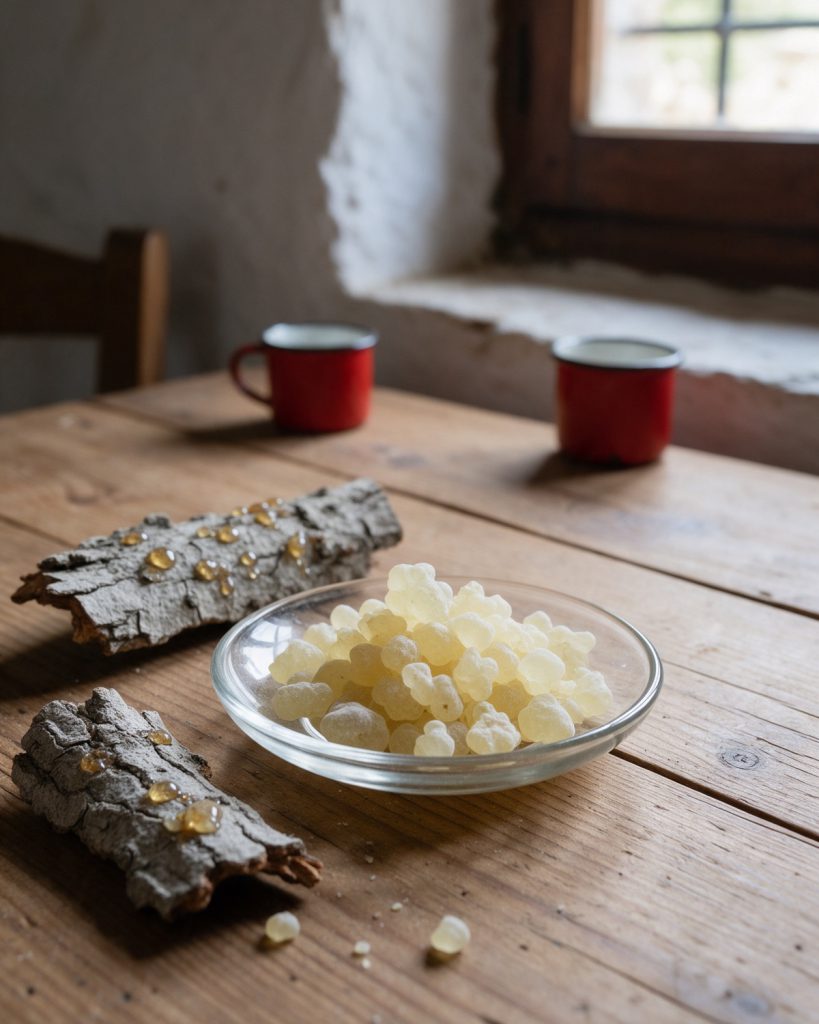
Two resins sit side by side in Greek shops and look alike under a lamp: amber, the fossil resin of old komboloi beads, and mastiha, the living resin of the Chios mastic tree. The salt-water float test is a fair first check for amber. It is no use at all for mastiha, and it is worth knowing why before you try it on either.
Part one: amber beads
The komboloi grew out of the komboskini, the knotted prayer rope used by monks on Mount Athos, and has been an everyday object in Greece and Cyprus since the middle of the twentieth century. Amber has always been the prized material. That makes amber the material most often imitated, with pressed amber, copal (a younger, not fully fossilised resin), phenolic resins and ordinary plastics.
A second trap is a word. Faturan was an amber-based compound used for beads, and genuine faturan stopped being made in the 1940s. A strand sold today as new faturan is a warning sign rather than a description.
The float test
- Stir table salt into a glass of warm water until no more will dissolve. A little undissolved salt at the bottom tells you the water is saturated.
- Take the beads off the strand, or test the whole strand if the cord and tassel are light.
- Drop the beads in. Wait a minute and nudge them to release air bubbles.
Amber has a specific gravity of roughly 1.05 to 1.10, a little heavier than fresh water and lighter than saturated brine. Real amber therefore sinks in plain water and floats in the salt solution. Glass, stone and most dense plastics sink in both. Rinse the beads in fresh water afterwards.
How far to trust it
This is a density screen used by amber dealers and collectors. It is not a gemmological identification. The known gaps:
- Copal floats too. So do some plastics, including polystyrene. A floating bead is consistent with amber, not proof of it.
- Metal fittings, drilled holes and cords change the result. Test loose beads where possible.
- Follow-up tests are harsher. Dealers use a drop of acetone (copal and many plastics turn tacky, amber does not), friction on wool (amber picks up a static charge and a faint resin smell), or a hot needle. Each can mark a bead, so do them only on a hidden spot and only on a strand you own.
For a strand priced in the hundreds of euros, ask a gem laboratory. Infrared spectroscopy separates amber from copal and synthetics reliably, and a float test cannot.
Part two: why not mastiha
Mastiha is the resin of Pistacia lentiscus var. Chia, scraped from the bark and dried into tears in the southern mastic villages of Chios, the Mastichochoria. It has been a Protected Designation of Origin since 1997 under the name Masticha Chiou, and the know-how of cultivating mastic on Chios has been on the UNESCO Representative List of the Intangible Cultural Heritage of Humanity since 2014.
It is tempting to treat mastiha tears like amber and drop them in brine. We looked for a published density or float test for mastic and did not find one we could cite. Fresh resin, dust from the harvest and the powdered coating on some tears would all change the result. So we do not recommend it, and we will not put an uncited test on a product page.
What does work for mastiha
- The registered name. Only resin from southern Chios may be sold as Chios Mastiha. Look for the exact PDO name Masticha Chiou on the pack. Mastic from other lentisk sources, or blends, cannot carry it.
- The handling chain. The Chios Mastiha Growers Association holds exclusive handling rights for the crop. A genuine pack traces back to the Association or to a packer licensed to use the PDO name.
- The register. The EU eAmbrosia register lists the designation and its specification. Our record for each mastiha SKU links to it directly.
Selling an imitation under the protected name is unlawful in the EU and in markets with geographical indication agreements with the EU. That legal protection does more for a buyer than any kitchen test.
What PINAX sells, and does not
The komboloi in our catalogue is hand-strung horn, not amber, and its record says so. We do not sell amber or coral strands at launch: amber because we cannot yet document it to our standard, coral because some species need CITES paperwork. Our mastiha is sold only in its original PDO pack, never repacked, and it stays marked Being verified until a licensed packer is signed.
Sources
- Greek Reporter: the history of the komboloi (2024)
- Wikipedia: Faturan
- Komboloi Museum, Nafplio
- Gemological Institute of America, Gem Encyclopedia: Amber (amber is light enough to float in a saturated salt solution; treatments and imitations)
- Buy Baltic Amber: amber and copal compared (copal also floats)
- EU eAmbrosia register: Masticha Chiou PDO
- UNESCO: Know-how of cultivating mastic on the island of Chios (2014)
- Chios Mastiha Growers Association: Mastiha, a PDO product