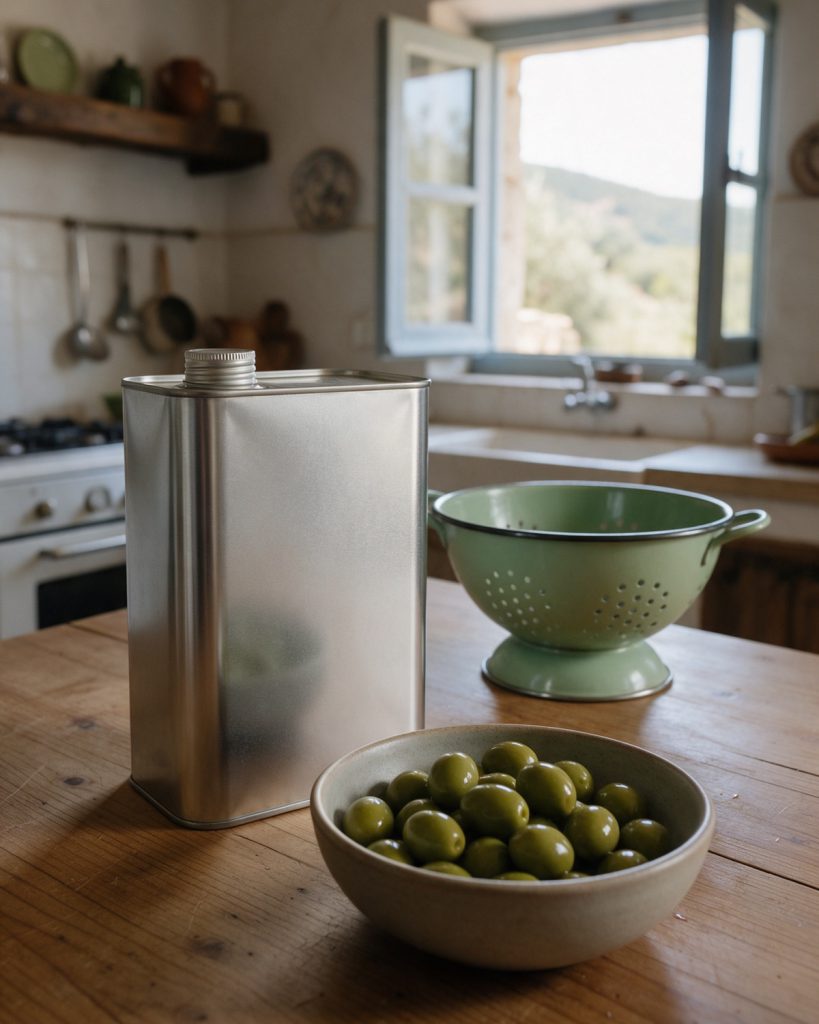
Kalamata is a city in Messinia, a protected name for olive oil, a protected name for table olives, and also, since a Greek ministerial decision in December 2016, an accepted synonym for an olive variety grown anywhere. The same word on two labels can mean two very different things. This note shows how to read them.
Three things called Kalamata
1. A place. Kalamata is the capital of Messinia in the southern Peloponnese, administrative region GR-J.
2. Two EU protected names. The EU register protects Kalamata as a Protected Designation of Origin for extra virgin olive oil, and Elia Kalamatas (Kalamata olive) as a PDO for table olives, registered in June 1996. A PDO means that production, processing and preparation all happen in the defined area, to a published specification, under inspection.
3. A variety. The dark, almond-shaped table olive most people picture is the Kalamon variety. Outside the EU and its partner markets, olives of that variety are sold as Kalamata olives wherever they grow, including the United States and Australia. Inside the EU they are normally sold as Kalamon.
The 2016 decision
Greece’s Ministry of Rural Development and Food published Ministerial Decision 3247/137259/2016 in the Government Gazette (issue 4044/B, 16 December 2016). A list of olive varieties in it gave Kalamata as a synonym for the Kalamon variety, alongside Kalamatiani, Tsingeli and Aetonychi.
Early in 2017 a Member of the European Parliament asked the Commission whether this turned a protected name into a generic term. The question cited Article 13 of Regulation (EU) No 1151/2012, which protects registered names against direct or indirect commercial use on comparable products that are not registered. Further parliamentary questions on protecting Elia Kalamatas followed in 2021. The practical result for a shopper is simple: the word Kalamata on a label no longer tells you, on its own, that the product came from Messinia.
How to read a label
Olive oil
- Look for the full wording. Kalamata PDO, or Protected Designation of Origin next to the name, plus the EU PDO symbol (red and yellow). A bare Kalamata in large type with no PDO wording is a brand or a style, not the designation.
- Look for the variety line. Oil described as made from Kalamata or Kalamon olives is a statement about the tree, not the place. Much Greek oil, in Messinia as in Crete, is pressed mainly from Koroneiki; Kalamon is grown chiefly as a table olive. Ask which variety is in the tin.
- Look for the harvest and the mill. A serious PDO tin names the harvest year and the mill or bottler. If a label names neither, ask.
Table olives
- Elia Kalamatas PDO on the jar, with the symbol, means Messinian olives under the specification.
- Kalamata olives with no PDO wording can be Kalamon olives from any country. They may be good olives. They are not the designation.
- Kalamata-style or Kalamata type means a method or appearance, and nothing about origin.
Check it yourself
The EU register, eAmbrosia, lists every protected food name with its specification and the date of registration. Search for Kalamata and you will see the olive oil and the table olive listed separately. A seller who uses the name correctly should be able to tell you which entry applies and who certified the batch.
What PINAX sells
We stock Kalamata PDO extra virgin olive oil in a 500 ml harvest-dated tin, from a Messinian PDO bottler still to be signed, so the record reads [partner to be sourced] and the product is marked Being verified. The label must show the full registered name, the harvest year and the mill before it goes on sale. We do not sell table olives at launch, because brine in transit is a packaging problem we have not solved to our standard.
We also stock Kolymvari Chanion Kritis PDO oil from western Crete. Its name is longer and harder to say, and nobody uses it as a variety.
Sources
- European Parliament, question E-000459/2017: Protection of the PDO name Elia Kalamatas from Greek Ministerial Decision 3247/137259
- European Parliament, question E-002172/2021: Protecting the Elia Kalamatas PDO
- Wikipedia: Kalamata olive (Kalamon variety and naming outside the EU)
- EUR-Lex: Regulation (EU) No 1151/2012 on quality schemes for agricultural products and foodstuffs
- Elenianna: Greek PDO olive oil regions (secondary source)
- Critida: Greek PDO and PGI olive oils, list and specifications (secondary source)
- EU eAmbrosia register of geographical indications