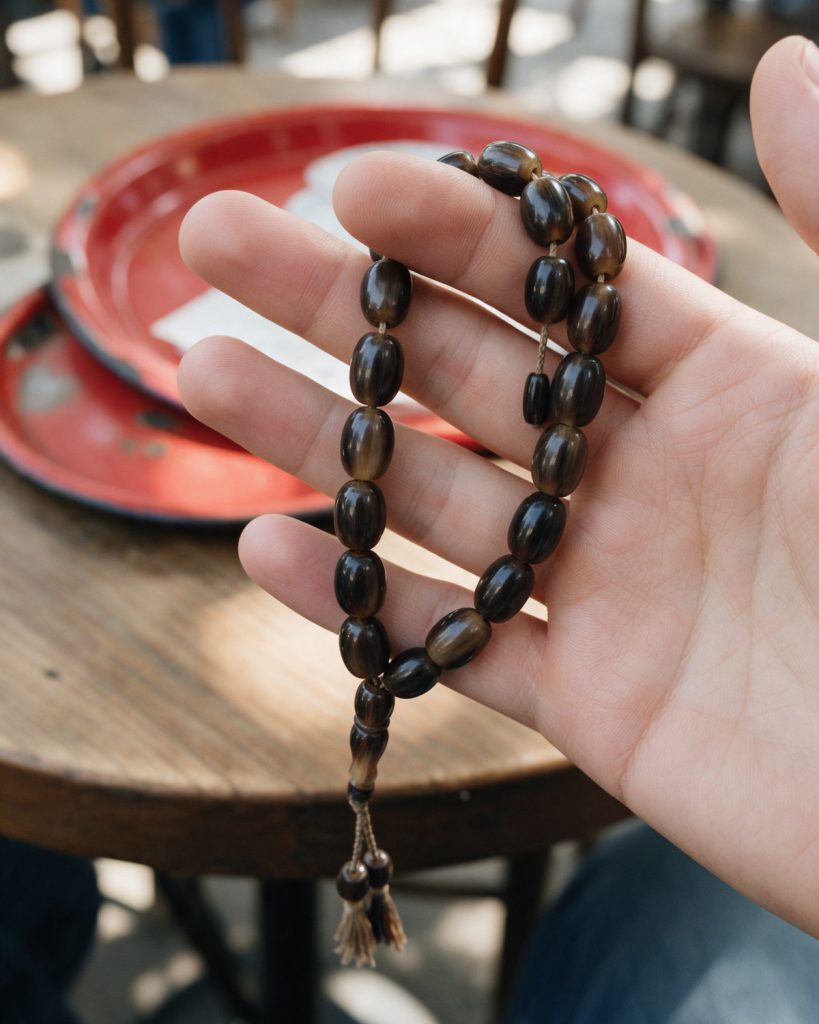
A komboloi (κομπολόι) is a loop of beads that people in Greece and Cyprus pass through their fingers for the feel and the click, not to count prayers. It grew out of the Orthodox prayer rope, but it is not a religious object. Below: how it is handled, what the bead count tells you, and how to tell horn, amber and resin apart.
From prayer rope to pocket
The Komboloi Museum in Nafplio arranges its collection along what it calls a historic root. Hall A holds Hindu, Buddhist and Muslim prayer beads, Hall B Christian Orthodox and Catholic prayer beads, and Halls C and D Greek kombolois. By the museum’s own estimate, the strings on display date from about 1550 to 1950.
The museum pages we read give no date for when the komboloi became an everyday Greek object. Greek Reporter, a secondary source, says it has been widely established in Greece and Cyprus since the middle of the twentieth century, that the word starts from kombos, knot, and that the first knotted strings were made by monks on Mount Athos. We did not find a primary history that dates it more exactly.
Not a religious object: komboloi and komboskini
The κομποσκοίνι (komboskini, the Orthodox prayer rope) is a devotional object. St George Greek Orthodox Cathedral in Greenville describes ropes of 33, 50 or 100 knots, with the Jesus Prayer said on each knot. The komboloi kept the loop and dropped the prayer. Greek Reporter notes that modern worry beads are often not designed for religious or ceremonial purposes.
| Point | Komboloi | Komboskini |
|---|---|---|
| Purpose | Handled for touch and sound | Prayer, one prayer per knot |
| Built from | Loose beads on a cord, with a head bead, a shield and a tassel | Knots tied in a rope |
| Count | No documented rule, see below | 33, 50 or 100 knots, sometimes more |
| Sold by PINAX | One horn string, being verified | No. We do not sell prayer ropes or other devotional items. |
How people handle one
Greek Reporter describes two common ways and a third, quieter one.
- Tipping, quiet. Start at the shield end. Pull the cord forward with the thumb and the side of the index finger until a bead arrives, then tip the cord so the bead drops against the shield. Repeat to the end of the string and start again.
- Swinging, louder. Split the beads into two groups: the shield and a few beads on one side, the rest on the other. Rest the bare cord between them across the index and middle fingers, palm towards you, and swing the back group up and over so it strikes the front group.
- Rolling. Hold the whole string in one hand and roll the beads against each other.
Some articles add that handling beads eases stress or helps people stop smoking. We found no clinical source for either, so we make no such claim.
Counting beads: what is documented and what is folklore
Greek Reporter names the parts: a fixed head bead, called the priest; a shield that separates the two threads and lets the beads run; and a tassel. It gives the length as about two palm widths and says the count is generally odd, often one more than a multiple of four, or a prime such as 17, 19 or 23.
That is one secondary source, and it gives no reason for the numbers. The museum pages we read give no rule. So treat any story about what a particular count means as folklore. The knot counts of the prayer rope, by contrast, come from an Orthodox cathedral’s own page. Count the beads only to check that a string matches its listing.
Materials: horn, wood, amber, resin, and why no coral
The museum lists the materials in its collection as pure amber, mastic-amber, faturan-amber, black coral (yusuri) and red coral, ivory, bone, horn and ebony. For the common ones, a paper in BEADS: Journal of the Society of Bead Researchers gives practical checks.
| Material | What the sources say | Check |
|---|---|---|
| Horn | A red-hot needle does not sink in. Dust from horn beads may smell faintly of burned hair. | Hot needle inside the hole only, with care |
| Amber | Specific gravity 1.05 to 1.10. A hot needle sinks in, and the dust smells of pine. | See our amber float test |
| Phenolic resin, including faturan | Specific gravity 1.35 to 1.38, so much denser than amber. A hot needle does not sink in. Fresh dust smells musty and medicinal, of phenol. | Weigh and measure, or smell the dust from the hole |
| Wood | The museum lists ebony. We found no cited home test for wood species. | Ask the seller for the species in writing |
| Coral | All black corals are on CITES Appendix II. Four red and pink species are on Appendix III. | Refuse without CITES paperwork |
The hot needle marks a bead and gives off fumes, and celluloid is very flammable. Use it only on a string you own.
On coral: the CITES Appendices valid from 5 March 2026 list the whole order Antipatharia, the black corals, on Appendix II, and Corallium japonicum with three Pleurocorallium species on Appendix III at China’s request. New Zealand’s Department of Conservation guidance adds that black coral stays covered even as fragments. Not every red coral is listed, but a polished bead does not show its species. We do not sell coral strings at all.
The ‘faturan’ problem
Faturan was a trade name, not a gem. It was a cast phenol formaldehyde resin, a plastic in the same family as Bakelite, made by Dr. Heinrich Traun and Son of Hamburg from the early twentieth century until the 1940s. The same bead paper recorded in 2016 that phenolic stock and beads were still being made, and that at least one company sold new material as “original German Catalin and Faturan”. It also cites research showing that old faturan darkens to red at the surface over time, and that new beads cut from old faturan turned red within weeks.
So a string sold as faturan may be pre-war resin, new resin under an old name, or something else. None of those is amber. The eye will not settle it either: the Gemological Institute of America’s journal reports a rosary submitted for amber identification that held 71 heat-treated amber beads and 31 Bakelite beads, which the examiners said even an experienced person could not tell apart unaided. They needed refractive index, UV fluorescence and infrared spectroscopy. Price a faturan string as resin unless a laboratory report says otherwise.
Nafplio and its museum
The Komboloi Museum is at 25 Staikopoulou Street in Nafplio, Argolis, in the Peloponnese (GR-J). It was founded in April 1998 by Aris Evangelinos and Rallou Gromitsari and reports more than 350,000 visitors since opening. Its workshop has a stated purpose: to conserve old strings and to make exact replicas of the ones on display.
Our record describes our komboloi as Nafplio tradition. That names the style we are sourcing, not a signed workshop. The museum is not our supplier.
What PINAX sells and what we have not verified
- Komboloi, horn beads, hand-strung, EUR 45.00. Being verified. The Nafplio workshop is not yet signed, so the maker reads [partner to be sourced] and there is no add to cart. You can join the waitlist on the product page.
- Peloponnese box, with fir honey, Kalamata olive oil and the horn komboloi. Being verified, because a box can only be sold when every object in it is. Greece and the EU only at launch.
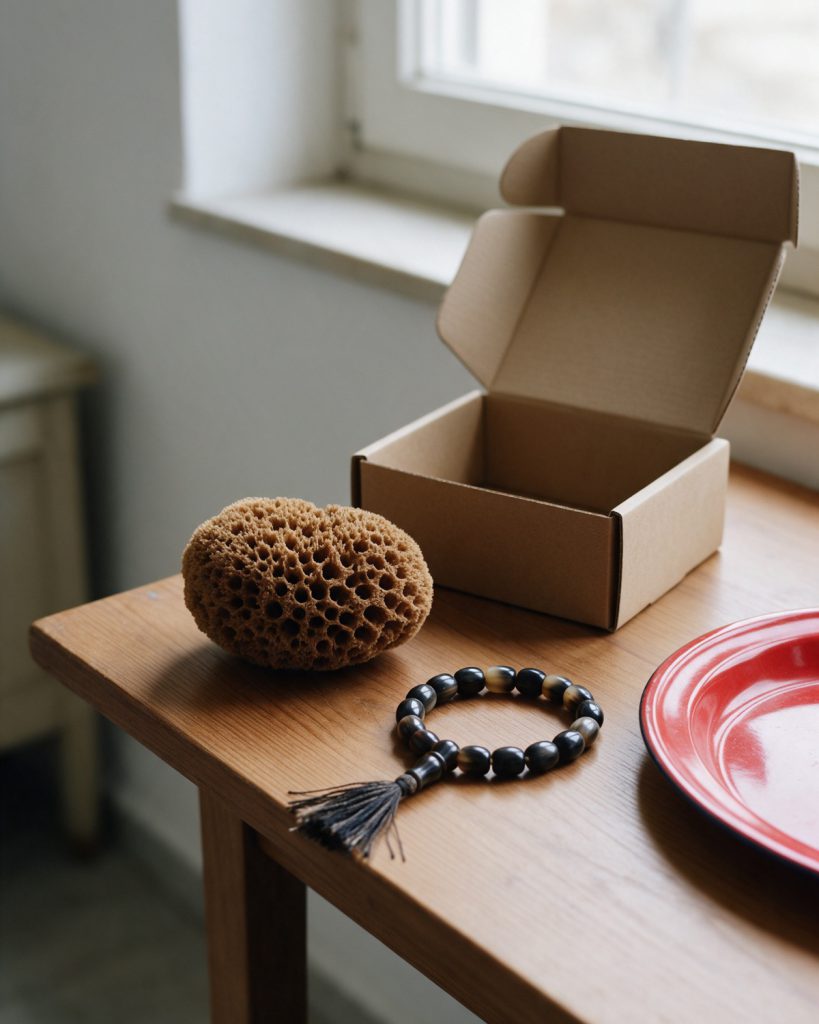
- Anywhere box, a Kalymnos sponge and the horn komboloi, with no food inside. Being verified. Planned for Greece, the EU, the US and Canada.
- For gifts to ten or more people, see corporate orders, quoted per order.
We do not sell prayer ropes, amber strings, coral, ivory, or anything labelled new faturan. Horn does not go to Australia yet: the Australian Border Force says most horn is allowed in if it is clean, but we have not run the commercial import check for a parcel. What every origin record contains is set out in The record.
Sources
- Komboloi Museum, Nafplio: the story of the museum (founding, halls, materials, workshop)
- Komboloi Museum, Nafplio: home page (address, collection materials)
- Greek Reporter: The history and how to of komboloi (2024), secondary source for history, parts, counts and handling
- St George Greek Orthodox Cathedral, Greenville: The Orthodox prayer rope
- Falabella, R. Imitation amber beads of phenolic resin from the African trade. BEADS: Journal of the Society of Bead Researchers 28 (2016) (PDF)
- Gems and Gemology, GIA: Plastic amber imitation in a rosary (Spring 2017)
- Wikipedia: Faturan (manufacturer and production dates)
- CITES: Appendices I, II and III, valid from 5 March 2026
- New Zealand Department of Conservation: CITES-listed corals, identification and guidance (PDF)
- Australian Border Force: list of items you can and cannot bring in (animal horns, teeth or bones)