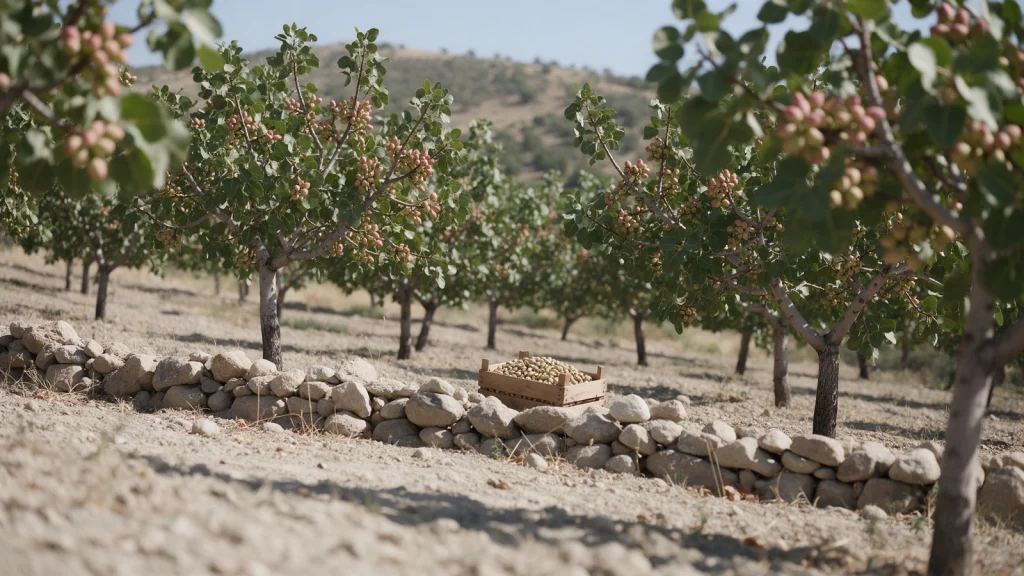
An Aegina pistachio, in the protected sense, is an in-shell pistachio of the local Aegina variety, grown on the island of Aegina in the Saronic Gulf and prepared there, sold under the EU Protected Designation of Origin registered in 1996. The word Aegina on a bag at a harbour stall is not the same thing. The check is on the pack: the registered name, the EU symbol, a named producer, and a certified packer.
Why Aegina, and what the PDO covers
The EU register, eAmbrosia, lists the name in Greek as Φυστίκι Αίγινας (Aegina pistachio) and in Latin script as Fystiki Aeginas, file PDO-GR-0426, protected since 2 July 1996 by Commission Regulation (EC) No 1263/96. The register has no modern single document for this name. What it holds is the 1996 summary sheet from the original application, filed by the Egina Agricultural Cooperative. That sheet sets out the essentials:
- Product. Pistachio nuts in shell, elongated, with green flesh.
- Variety. The traditionally cultivated Aegina variety (Aiginitiki).
- Area. The municipality of Aegina and the communes of Kypseli, Mesagros, Vathy and Perdika, all on the island.
- Origin. Produced on the island, where treatment and market preparation are carried out.
- Method. Traditional treatment including roasting and salting.
The Agricultural Cooperative of Pistachio Producers of Aegina says organised cultivation on the island began in the late nineteenth century, that Aegina was the first place in Greece where the pistachio was grown systematically, and that this is why the Greek variety itself came to be called Aegina. By the cooperative’s figures the island has 3,500 stremmata (about 350 hectares) and 120,000 pistachio trees. Founded in 1947, it has 347 members and collects, processes and sells about 30% of the island’s crop. It describes the orchards as semi-dry cultivation on limestone soils near the sea.
Aegina belongs to Attica, the region around Athens. For what else we list from there, see Attica.
Harvest to split shell
The pistachio tree is either male or female, and pollen travels on the wind. Qualigeo, the Qualivita Foundation’s database of European PDO and PGI products, gives the working year: pruning during winter rest from November to March, female flowering in the first two weeks of April, and harvest from the end of August into September. Pickers use rods tipped with rubber or cloth so the branches are not damaged, and the fruit goes quickly to what Qualigeo calls shell breaking machines, and then to market. Under that soft hull is the shell, and inside it a kernel Qualigeo describes as intense green with a purplish skin.
The season is not fixed. In September 2026 the Agricultural Association of Aegina told the local site Aegina365.gr, in an interview republished by the farm paper Ypaithros, that the harvest was in its final stage and the crop noticeably smaller. Its reasons: trees on the island need at least 400 hours below 7°C in winter and recorded about 80; psyllid damage the year before cost buds; and the seed wasp Eurytoma did further damage. It also recalled 2023, when drought cut the average yield to 320 grams a tree against a usual 5 to 6 kilos. It expects the small crop to push both producer and retail prices up.
Roasting with salt: what the PDO allows
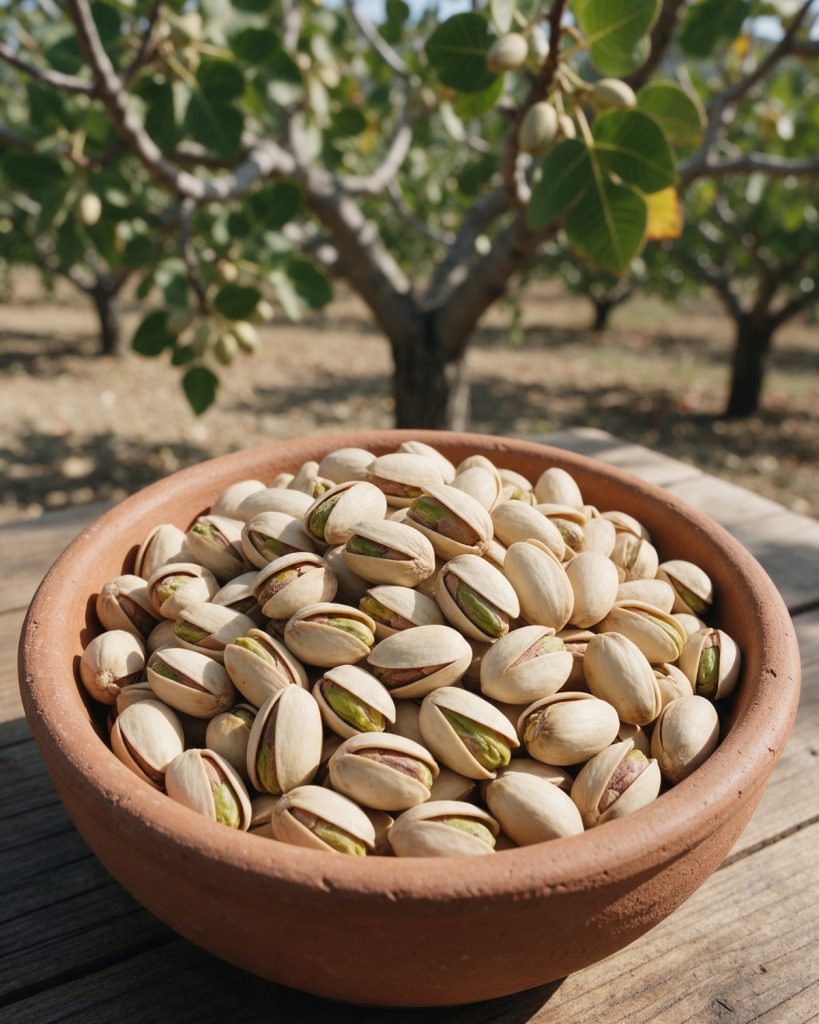
The 1996 sheet names roasting and salting as the traditional treatment, so a roasted and salted nut in its shell sits inside the description. The sheet does not specify the type of salt, a roasting temperature or a moisture level, and no later specification is published in the register. A pack that says roasted with sea salt is describing the packer’s own method, not a PDO requirement. Qualigeo adds that the nuts are eaten shelled, toasted and at times salted, and used in pastry and ice cream.
Island shops and pistachios from elsewhere
We do not have a measured share of non-island pistachio sold on Aegina, and we have not found one published. What we can cite is the producers’ own account. In the September 2026 interview the Agricultural Association of Aegina called products of other origin sold or presented as Aegina pistachios a huge, open wound for the island. It said some growers still held the previous year’s crop unsold while shelves were full and buyers could not be sure the nuts were grown on Aegina.
The Association made three practical points. Ask for the registered name with PDO and the official certification mark on the pack. The phrase in-shell Aegina pistachio is not a registered term; the Association calls it a trade idea to muddy the water. And packs sold on the island marked only as Greek in-shell pistachio should, in its view, name the grower and the orchard area. That last point is a proposal, not a legal requirement. The same logic applies to olive oil, where a place name has also become a variety name: see the Kalamata naming trap.
How to check a pack
| Check | What to look for | Basis |
|---|---|---|
| Name | Fystiki Aeginas, or the Greek name in the register, with Protected Designation of Origin or PDO. The cooperative itself uses the everyday spelling Fistiki Aiginis. Bare Aegina, Aegina style or in-shell Aegina pistachio is not the designation. | eAmbrosia entry; Association interview |
| EU symbol | The red and yellow PDO symbol in the same field of vision as the name. | Regulation (EU) 2024/1143, Article 37(3) |
| Producer or operator | A named producer or operator next to the name. Required for labels printed from 14 May 2026; older labelled stock may still be sold until it runs out. | Regulation (EU) 2024/1143, Article 37(5) |
| Control code | The 1996 file describes a control code: AI, the label serial number, and the last two digits of the production year. We have not seen a current pack to confirm the format is still used, so treat it as a question to ask. | 1996 summary sheet |
| Certification | A packer able to show current PDO certification. In Greece, ELGO-DIMITRA’s Directorate of Certification and Specifications oversees compliance of registered PDO and PGI products. The cooperative states it is certified by AGROCERT of the Ministry of Rural Development and Food. | ELGO-DIMITRA via APE-MPE; cooperative |
| Allergen | Pistachio emphasised in the ingredients list, for example in bold. | Regulation (EU) No 1169/2011, Article 21 and Annex II |
We know of no kitchen test that tells an Aegina nut from a pistachio grown elsewhere. Origin rests on the label, the certificate and the packer, which is why the origin record for each object links to its register entry.
Nut allergen note
Pistachio nuts (Pistacia vera) are one of the nuts listed in Annex II of Regulation (EU) No 1169/2011, the EU list of allergens that must be declared. On prepacked food the name must be emphasised in the ingredients list. For food sold loose, allergen information is still mandatory under Article 44, though Member States set how it is given. Roasted, salted, shelled or in a sweet, a pistachio is still a nut allergen. If you cook for someone with a nut allergy, the saffron pilaf with currants in our kitchen notes uses pistachio as a garnish that can be left off.
What PINAX sells and what we have not verified
The page to buy Aegina pistachios lists a 227 g pack of in-shell pistachios, roasted and salted, under the Fystiki Aeginas PDO. It is marked Being verified. No PDO packer is signed, so the record reads Maker: [partner to be sourced], and nothing ships until a signed packer’s label carries the registered name, the EU symbol, a named operator and a current certificate. If you want a pack when the packer is signed, join the waitlist on the product page. Other PDO foods we list are gathered under protected pantry.
Sources
- EU eAmbrosia register: Fystiki Aeginas PDO, file PDO-GR-0426
- eAmbrosia: 1996 application summary sheet for Egina pistachio PDO, English (PDF)
- EUR-Lex: Commission Regulation (EC) No 1263/96 of 1 July 1996
- Qualigeo (Qualivita Foundation): Fystiki Aeginas PDO
- Agricultural Cooperative of Pistachio Producers of Aegina: home page, history and figures (Greek)
- Agricultural Cooperative of Pistachio Producers of Aegina: certifications (Greek)
- Ypaithros, 10 September 2026: Agricultural Association of Aegina on the reduced crop and adulteration, from Aegina365.gr (Greek)
- iefimerida, 1 June 2025: four-year review of ELGO-DIMITRA’s Certification Directorate, via APE-MPE (Greek)
- EUR-Lex: Regulation (EU) 2024/1143 on geographical indications, Article 37
- EUR-Lex: Regulation (EU) No 1169/2011 on food information to consumers, Articles 21 and 44 and Annex II