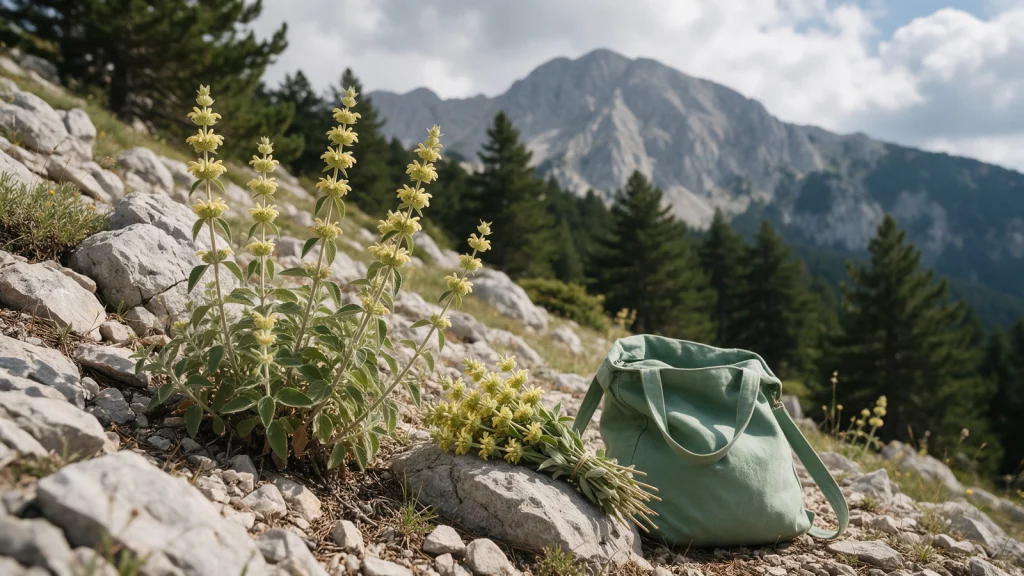
Greek mountain tea, τσάι του βουνού (tsai tou vounou, tea of the mountain), is the dried flowering stems of Sideritis, a plant with 17 species native to Greece. Four of those species are grown as field crops. We sell only cultivated, certified-organic whole stems, because the Olympus species is listed as Near Threatened and a whole stem lets you see what you bought.
One name, about 17 species
The European Medicines Agency’s 2016 assessment report counts 17 Sideritis species indigenous to Greece and ties several of them to a mountain: S. athoa to Mount Athos, S. clandestina to Helmos and Taygetos in the Peloponnese, S. scardica to Olympus, S. raeseri to Parnassus, S. syriaca to the mountains of Crete, where it is called malotira, and S. euboea to Euboea.
So “mountain tea” on a pack does not name a plant. The report lists four species as cultivated in Greece and Bulgaria: S. scardica, S. clandestina, S. raeseri and S. syriaca. The others are mainly harvested from the wild. They are also the four species in the EU herbal monograph described below.
Wild picking and the IUCN listing
Sideritis scardica is listed as Near Threatened on the IUCN Red List. A 2019 genetic study in Scientific Reports, with co-authors from the Hellenic Agricultural Organization, describes the plant as endangered “mostly because of human-mediated overexploitation” and asks collectors to adopt sustainable rules for picking it from the wild.
The EMA report adds that the tea’s popularity in Greece keeps increasing the area under cultivation. Stems grown in a field take nothing from a wild population.
Cultivated and organic: what the label proves
Under Regulation (EU) 2018/848, prepacked food sold as organic must carry the EU organic logo and the code number of the control body that checked the last operator. In the same visual field as the logo the pack must say where the raw material was farmed: EU Agriculture, non-EU Agriculture, or the name of a country when all of it was farmed there.
The logo does not prove that the plant was cultivated. Annex II of the same regulation counts the collection of wild plants as organic production, provided the area had not been treated with substances outside the organic rules for three years and the collection “does not affect the stability of the natural habitat or the maintenance of the species in the collection area”. Wild-collected organic mountain tea can be entirely legal, and the label will not tell you which kind you hold.
| On the pack | What it proves | What it does not |
|---|---|---|
| EU organic logo and control body code | Certified under Regulation (EU) 2018/848 | That the plant was grown in a field rather than collected wild |
| EU Agriculture, or a country name | Where the raw material was farmed | Which mountain, grower or species |
| A species name | Which plant the packer declares | Origin or method |
| Greek mountain tea | Nothing protected | Species, place or method |
For that, ask the seller whether the stock is a field crop, and from where.
Whole stems vs cut tea: what you can see
A 2019 review by researchers at the Hellenic Agricultural Organization “Demeter” and the University of Thessaly describes the crop. Growers harvest at full bloom, cutting the whole flower spike with 10 to 15 cm of stem beneath it. Lower fields are usually ready around mid-May, and the harvest moves uphill from there. The bundles dry in ventilated sheds out of direct sun, which takes five to eight days without machines and keeps a greenish-yellow colour. Plants dried without shade, or in wet weather, lose colour and quality.
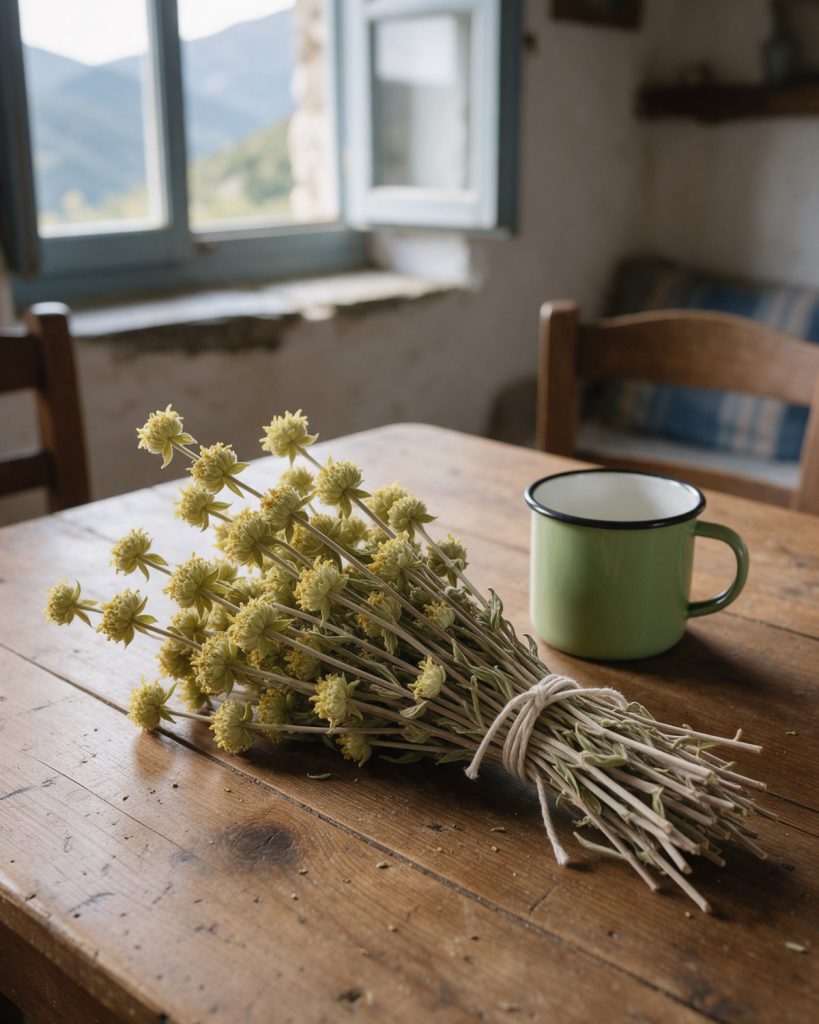
Packed whole, you can see flower spikes still on their stems, and whether the colour is greenish-yellow or has turned brown or bleached from poor drying. Cut or crushed tea may be perfectly good, but it shows none of this. It is the same reasoning as in our note on oregano adulteration, where whole leaves are the only form a buyer can screen by eye.
Brewing from whole stems
Both amounts below come from the EMA documents. The traditional Greek way, the assessment report says, is to boil stems, leaves and flowers in a pot, often served with honey and lemon. The monograph measures a single cup.
- Break 2 to 4 g of stems into a mug. A 40 g pack makes ten to twenty cups.
- Pour over 150 to 200 ml of boiling water. For a family pot, use 15 to 25 g in about a litre and bring it to the boil.
- Cover and leave for about ten minutes, as in one of the infusion methods the report lists, then strain. Add honey or lemon if you like.
What the European Medicines Agency says, and what it does not
In February 2016 the EMA’s Committee on Herbal Medicinal Products adopted a monograph on the aerial parts of S. scardica, S. clandestina, S. raeseri and S. syriaca, taken as a herbal tea. It gives two indications, both as a “traditional herbal medicinal product”:
- “used for the relief of cough associated with cold”, with a doctor to be consulted if symptoms last longer than one week;
- “used for the relief of mild gastrointestinal discomfort”, with a doctor to be consulted after two weeks.
The monograph states that these uses are “exclusively based upon long-standing use”. The assessment report is plainer still: for clinical efficacy it lists “No data available” and notes “a lack of controlled clinical studies”. Traditional use means the uses are made plausible by long experience and are regarded as not harmful for those minor complaints. It does not mean trials have shown that they work.
The monograph’s cautions:
- Not for anyone hypersensitive to Sideritis or to other plants of the mint family, Lamiaceae.
- Not recommended under 18 years of age, for lack of adequate data.
- Not recommended during pregnancy or breastfeeding, because safety has not been established.
- If symptoms worsen, see a doctor.
- No interactions are reported and no side effects are known, but tests on reproductive toxicity and carcinogenicity have not been performed.
That is the whole of the EU position, and we make no other claims. Our pack is sold as a herbal tea, not as a registered medicinal product.
No geographical indication, and what that means
On 14 September 2026 we downloaded the public data of eAmbrosia, the EU register of geographical indications: 4,015 food, wine and spirit names, 286 of them from Greece. No entry protects mountain tea, τσάι του βουνού or Sideritis, from Greece or from anywhere else.
Unlike Krokos Kozanis saffron, which our saffron note traces to a PDO register entry, mountain tea has no entry, so no official specification fixes its species, area or method, and there is no register to check. Greek on a pack is the seller’s word. That is why our record for it reads “No geographical indication. Origin rests on supplier audit.” It sits with the other foods in that position in our unprotected pantry.
What PINAX sells and what we have not verified
One product: organic mountain tea, 40 g, whole dried stems, leaves and flowers of cultivated Sideritis under organic certification, packed in a rigid sleeve so they do not break into dust. It is planned from the Mount Olympus area, on the Central Macedonia or Thessaly side, depending on the grower we sign.
It is marked Being verified. Today that means:
- No grower is signed. The maker line reads [partner to be sourced].
- The species goes on the record once the grower is signed, from their paperwork.
- Before sale we will ask for the organic certificate and the grower’s confirmation that the stock is a field crop, not wild collection.
- The price is an estimate, and our accountant still has to confirm the VAT rate for herbal tea.
- It is set to ship to Greece, the EU, the US and Canada. Not to Australia until a biosecurity import check, and not to the UK yet.
If a grower cannot show us a field and a certificate, the tea does not go on sale.
Sources
- European Medicines Agency, HMPC: European Union herbal monograph on Sideritis scardica, S. clandestina, S. raeseri, S. syriaca, herba, EMA/HMPC/39453/2015 (PDF, 2 February 2016)
- European Medicines Agency, HMPC: Assessment report on Sideritis scardica, S. clandestina, S. raeseri, S. syriaca, herba, EMA/HMPC/39455/2015 (PDF, 2016)
- IUCN Red List of Threatened Species: Sideritis scardica
- GBIF: IUCN Red List category record for Sideritis scardica (Near Threatened, IUCN taxon 203271)
- Grdiša et al., Scientific Reports (2019): Divergent selection and genetic structure of Sideritis scardica populations from the southern Balkan Peninsula
- Regulation (EU) 2018/848 on organic production and labelling of organic products, Articles 32 and 33 and Annex II, Part I, point 2.2
- European Commission: The organic logo
- Solomou, Skoufogianni, Mylonas, Germani and Danalatos, Asian Journal of Agriculture and Biology (2019): Cultivation and utilization of Greek mountain tea (Sideritis spp.), Hellenic Agricultural Organization “Demeter” and University of Thessaly (PDF)
- European Commission: eAmbrosia, the EU geographical indications register
- eAmbrosia public API: full list of geographical indications (downloaded 14 September 2026)