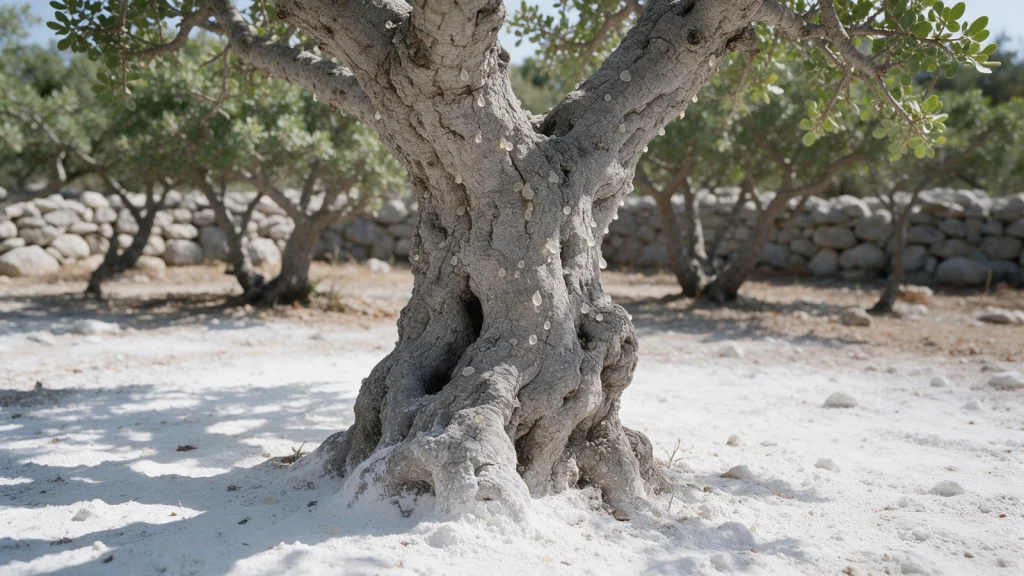
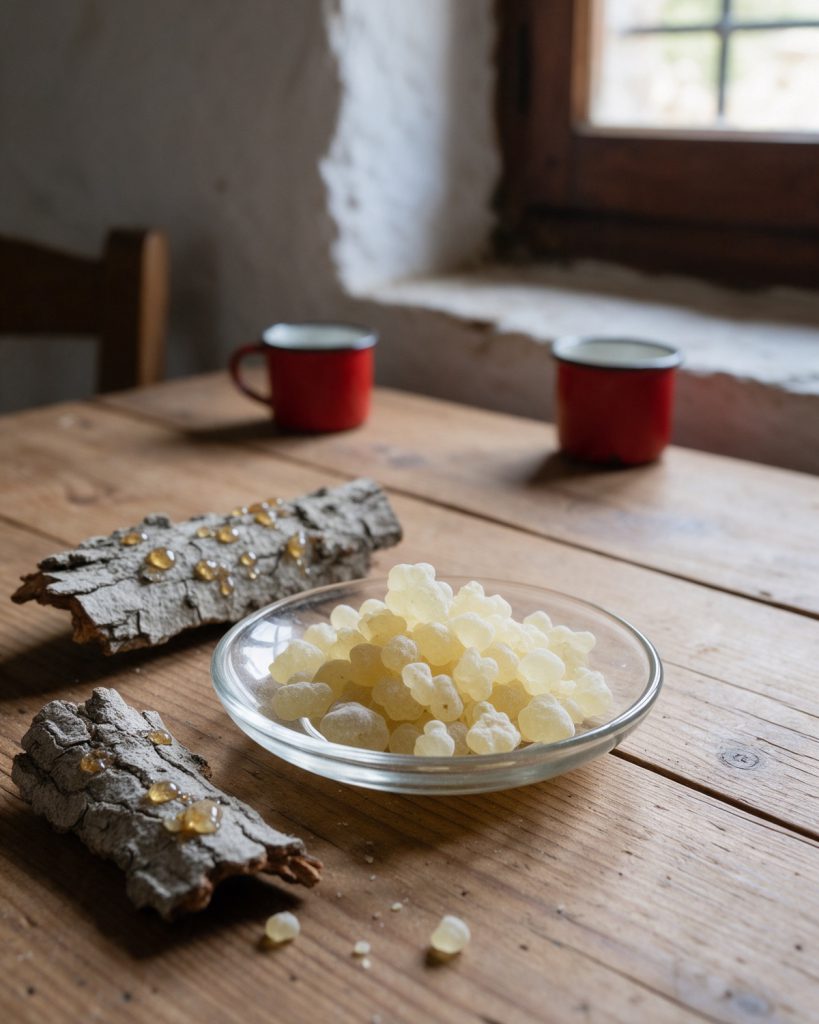
Mastiha (μαστίχα, mastic) is the dried resin of the mastic tree, Pistacia lentiscus var. Chia, cut from the bark in the villages of southern Chios every summer. It is sold as pale, brittle tears that are chewed as a natural gum or pounded with sugar or salt for sweets, bread and savoury dishes. Under the name Masticha Chiou it has been an EU Protected Designation of Origin since 1997.
The resin of one tree variety
Lentisk is an evergreen shrub of the Mediterranean maquis. The Chios Mastiha Growers Association names the tapped variety as Pistacia lentiscus var. Chia and notes that although lentisk grows across the whole island, mastiha is produced only in the south.
By the Association’s figures a tree yields nothing until its fifth or sixth year, is at its most productive after fifteen, and declines substantially after seventy. The average is 150 to 180 grams of mastiha a tree a year, with rare trees giving up to two kilos and others only 10 grams. A 50 g pack is therefore close to a third of one tree’s average year.
The mastic villages of southern Chios
The growing area is the Mastichochoria (Μαστιχοχώρια, the mastic villages), in the North Aegean region, ISO code GR-K. The Association, founded in 1938, represents 20 primary cooperatives in 24 villages and has about 4,500 members. Qualigeo, the database of European PDO and PGI products, gives the same count of 24 for the production area. Pyrgi, Mesta, Olympi, Armolia, Kalamoti and Nenita are among them.
The Chios Mastic Museum of the Piraeus Bank Group Cultural Foundation stands at Pyrgi. Its permanent exhibition includes a unit on the cooperative exploitation and processing of the resin in modern times. For the rest of the region and what else we list from it, see North Aegean on the map.
From scraping to tears: the season
UNESCO inscribed the know-how of cultivating mastic on the island of Chios on the Representative List of the Intangible Cultural Heritage of Humanity in 2014. Its description records a family occupation: men prune and fertilise in winter, women sweep and level the ground from mid-June, the bark is cut from July, and women later select and wash the larger tears. Older growers teach incision and harvesting to younger ones. The Association publishes the calendar in more detail.
| When | Work |
|---|---|
| Mid-January to February | Lower branches pruned to shape the tree and let air and light through, which also helps the resin dry. |
| Mid-June to early July | Ground around each trunk cleaned, swept and levelled, then covered with sifted white soil pressed flat, so drops that fall can be gathered clean. |
| July and August, sometimes to the end of September | Kentima: small cuts in the bark of the trunk and main branches, working upwards, made with the kentitiri, a small sharp iron tool with grooved ends. |
| 15 to 20 days after the first cut | The resin begins to solidify. |
| After 15 August | First gathering. The large pieces, called pites, come first, then the rest by hand or with brooms. |
| After the harvest | Tears stored in wooden boxes in a cool place, cleaned by hand and delivered to the cooperative, which processes the crop over about six months. |
The PDO and who handles the crop
Masticha Chiou was registered as a Protected Designation of Origin in 1997. The EU eAmbrosia register lists it as file EUGI00000013337. A PDO ties the name to a delimited area: resin from lentisk elsewhere, or a blend, may not be sold under it.
The Association describes itself as founded in 1938 as a compulsory agricultural cooperative under Law 1390, and as holding exclusive management of natural Chios mastiha in Greece and abroad. The European Commission’s exporter profile of the Association puts exports at about 70% of production, with 80% of those exports leaving the EU, and names Japan, Korea, Canada and Peru among the markets where EU trade agreements recognise the name as a geographical indication.
How mastiha is used
- Chewed as it is. Qualigeo’s product sheet notes that the resin can be eaten pure, with no chemical treatment. The Association’s advice for chewing is a mix of hard and soft tears, which stops the gum sticking to the teeth.
- Pounded with sugar for baking. Both the Association and the cookery writer Diane Kochilas say to grind a few tears with a little sugar for sweets, so the resin does not clump. Kochilas lists bread, Easter cheese pastries from the Aegean islands, cookies and koulourakia among its traditional uses.
- Pounded with salt for savoury dishes. The same two sources give salt in place of sugar. Kochilas notes that chefs now pair it with ingredients from chocolate to fish.
- In other products. Qualigeo also lists pharmaceutical and cosmetic production and alcoholic drinks as uses of the PDO resin.
The two sources disagree on tools. The Association says tears can go in a mortar or a spice grinder, frozen first and always with sugar or salt. Kochilas says to use a mortar and pestle only, because the sticky resin can ruin grinder blades. A cold mortar is the choice that satisfies both.
On storage, the Association says mastiha keeps for many years in a cool place away from light and recommends using it within three years. It also says the small, medium and large grades differ in size only, not in quality.
What sources say about mastic and health
We quote one source here and add nothing to it. In 2016 the European Medicines Agency’s Committee on Herbal Medicinal Products adopted a European Union herbal monograph on Pistacia lentiscus L., resina (mastic), reference EMA/HMPC/46758/2015. It lists no well-established use. Under traditional use it gives two indications for medicinal products made from the powdered resin:
- “Traditional herbal medicinal product used in mild dyspeptic disorders.”
- “Traditional herbal medicinal product used for the symptomatic treatment of minor inflammations of the skin and as an aid in healing of minor wounds.”
The monograph adds that such a product is “exclusively based upon long-standing use”. In other words, the committee recognised a long record of use, not proof from clinical trials. It covers registered medicinal products with set doses, it does not recommend oral use under 18 years of age or use during pregnancy and lactation, and it says nothing about resin eaten as food. The tears we list are a food. We make no health claim for them.
Fakes: see the amber note
We found no citable home test for mastiha, and the checks that do work (the registered name, the handling chain and the register entry) are set out in The amber float test. We do not repeat them here.
What PINAX sells and what we have not verified
- Chios mastiha tears, medium, 50 g (Masticha Chiou PDO), EUR 14.00. Being verified. We have not yet signed a licensed PDO packer, so the maker reads [partner to be sourced] and there is no add to cart. It will be sold only in its original PDO pack, never repacked. You can join the waitlist on the product page.
- Name day tin, which includes Chios mastiha with Krokos Kozanis saffron and Vostizza currants. Being verified for the same reason, with a waitlist.
What each origin record contains, and what we require before an item can be bought, is set out in The record.
Sources
- EU eAmbrosia register: Masticha Chiou PDO, EUGI00000013337
- UNESCO: Know-how of cultivating mastic on the island of Chios, Representative List (2014)
- Chios Mastiha Growers Association: Chios Mastiha, a PDO product
- Chios Mastiha Growers Association: The mastiha tree (variety, age, yield)
- Chios Mastiha Growers Association: Cultivation (season calendar)
- Chios Mastiha Growers Association: The entity (1938, cooperatives, villages, members)
- Chios Mastiha Growers Association: The villages
- Chios Mastiha Growers Association: FAQ (grinding, chewing, storage, grades)
- European Medicines Agency, HMPC: European Union herbal monograph on Pistacia lentiscus L., resina (mastic), EMA/HMPC/46758/2015, final, 2 February 2016 (PDF)
- Piraeus Bank Group Cultural Foundation: Chios Mastic Museum, Pyrgi
- Qualigeo: Masticha Chiou PDO (production area and uses)
- European Commission, trade policy: Chios Masticha Growers Association exporter story
- Diane Kochilas: What is mastiha and how to use it