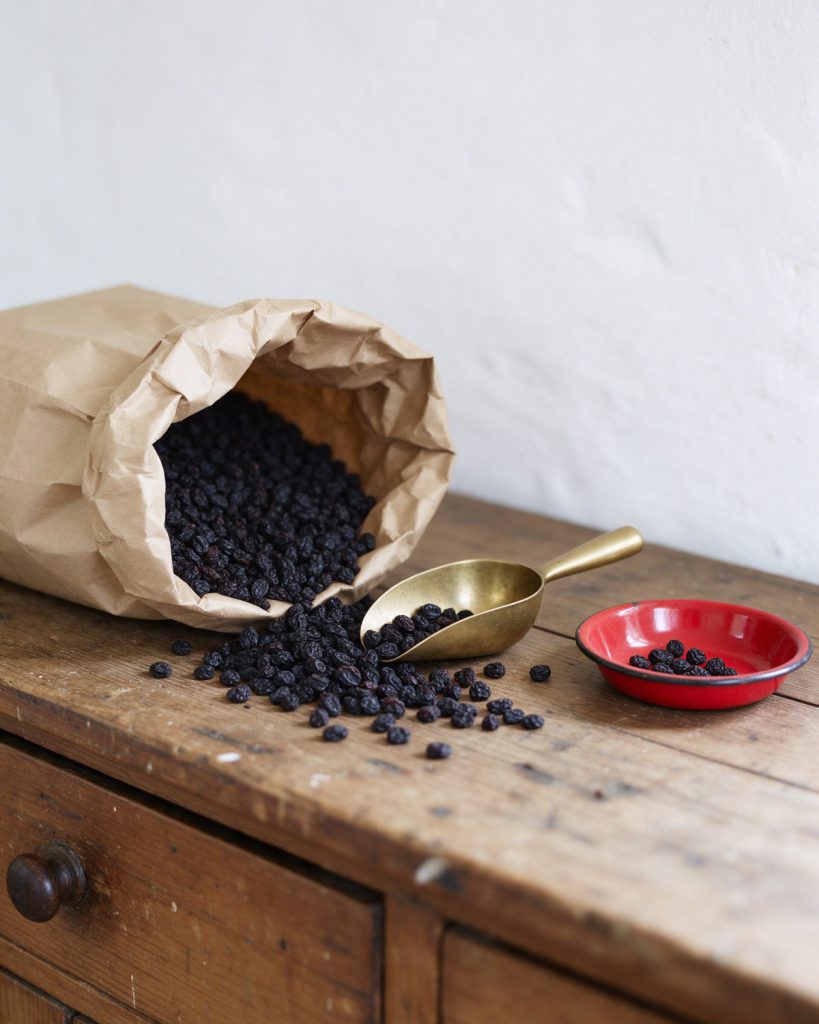
A Zante currant is not a currant. It is a raisin: the dried fruit of the small, seedless Black Corinth grape, Vitis vinifera. The red, black and white currants of a fruit garden are berries of the shrub Ribes, a different plant. The English word came from Corinth, the trade moved to Zakynthos, and today the finest grade grows in the hills behind Aigio, the medieval Vostitsa, where it is registered as Korinthiaki Stafida Vostitsa PDO. This note reads the words on the pack.
Five words, one fruit
The terms below are used loosely in shops and recipes. In trade documents and on a PDO label they mean something specific.
| Word | What it means |
|---|---|
| Raisin | Any dried grape of the Vitis vinifera varieties. The United States grade standard for processed raisins lists Thompson Seedless, Muscat of Alexandria, Sultana, Black Corinth and White Corinth among them. |
| Sultana | A dried grape of the Sultanina or Sultana varieties. Pale, larger and softer than a currant. The Aigio cooperative sells these as a separate line. |
| Currant, in a garden | A berry of the shrub Ribes: blackcurrant, redcurrant, whitecurrant. Sold fresh or as jam and cordial. Not a grape and not what a Greek pack contains. |
| Zante currant, Corinth raisin, Corinthian currant | The dried Black Corinth grape. The name is a worn-down form of the Anglo-French raisins de Corinthe. By the 17th century the trade ran through Zakynthos, which the Venetians called Zante, and the island’s name stuck to the fruit. The United States standard files it as Type V, Zante Currant Raisins. |
| Vostizza, Korinthiaki Stafida Vostitsa | The protected top grade of the same fruit, grown only in the semi-mountainous and mountainous part of Aigialeia around Aigio. Registered as a Protected Designation of Origin in 1998. EU register file EUGI00000013159. |
The grape
Black Corinth is a very small grape. The Raisin Production Manual of the University of California gives berries of 0.34 to 0.60 grams, round, reddish black, and practically seedless except in an occasional large berry. Dried, they turn dark brown to black. The same manual puts Greece at about 80 percent of world production, with California, South Africa and Australia sharing most of the rest.
The Aigio cooperative describes the Greek vine as Vitis vinifera L., grown on the northern and western coasts of the Peloponnese and on the Ionian islands, where the sea breeze and the sun suit the drying. It sorts the crop into three commercial grades: Vostizza PDO, Gulf and Provincial. Only the first carries the protected name.

Aigio, Vostitsa and the cooperative
Aigio sits on the south shore of the Gulf of Corinth, in Achaea, in the region of Western Greece, ISO code GR-G. In the Middle Ages the town was called Vostitsa, and the raisin trade kept the old name after the town dropped it. See Western Greece on the map for the rest of the region.
The growers’ body is the Panaigialios Union of Cooperatives, which trades in English as Farmers Union Vostizza. Its own history page gives the sequence:
- 1918. The Raisin Cooperatives Union is founded in Aigio.
- 1923. The Vostizza Raisin Bank is founded.
- 1935. The two merge into the Agricultural Cooperatives Union of Aigio.
- 1948. The first raisin factory opens on the Aigio waterfront.
- 1983. The first organic currants in Greece are grown, packed and exported.
- 1990. A new factory opens on the Union’s own site.
- 1998. The Vostizza currant is registered as a Protected Designation of Origin.
- 2012. The Union becomes a company limited by shares.
By its own figures the Union today processes about 60 percent of the annual Greek crop and about 90 percent of the Vostizza PDO grade, employs about 120 people a day, and exports to more than 40 countries, with the United Kingdom, the Netherlands, Australia and the United States named as the main markets.
How the fruit is dried
The Union describes the method in one line: the grapes are picked at full ripeness and dried in the sun. There is no added sugar and no oil coating in the PDO product. The dried fruit is then cleaned, sorted and packed at Aigio. The Union sells it in cartons of 10, 12.5 and 14 kilograms for the trade and in packs from 35 grams to 3 kilograms for shops.
The United States standard gives the numbers a buyer can check. Grade A Zante currant raisins contain not more than 20 percent moisture by weight and at least 75 percent well-matured or reasonably well-matured fruit. Size grades do not apply to this type: the fruit is small by nature.
What is in a pack, by the cooperative’s table
These are the Union’s published figures per 100 grams of Vostizza currants. We quote them and add nothing.
| Per 100 g | Value |
|---|---|
| Energy | 294 kcal |
| Protein | 2.5 g |
| Carbohydrate | 77.5 g |
| of which sugars | 68 g, mostly fructose (about 35 g) and glucose |
| Dietary fibre | 6.7 g |
| Potassium | 710 mg |
| Iron | 4 mg |
The Union calls the sugars simple sugars and makes claims about energy and glycaemic response. We do not repeat those. The currants we list are a dried fruit. We make no health claim for them.
Reading the label
The word currants alone, or Zante currants, or Corinth raisins, tells you the type of fruit and nothing about where it grew. Fruit from California or Australia can be sold under all three. The protected grade is proved by three things on the pack:
- The full registered name, Korinthiaki Stafida Vostitsa, or its Greek form Κορινθιακή Σταφίδα Βοστίτσα.
- The words Protected Designation of Origin or PDO, or the EU red and yellow PDO seal.
- A packer in Aigialeia. The Union at Aigio handles about nine tenths of the PDO grade, so its name or its Vostizza brand is the usual sign.
A pack that says Vostizza in large type but carries no PDO wording and no registered name is trading on the word. The register entry is public and you can read it at the link in the sources.
In the kitchen
Because the fruit is small and seedless, it goes into a dish whole and cooks in the time it takes rice to steam. Our recipe for saffron pilaf with Vostizza currants pairs it with Krokos Kozanis saffron, two PDO foods from two regions in one pan. How to steep the saffron for that dish is in How to use saffron threads. In Britain the same fruit is what a recipe means by currants in an Eccles cake, a teacake, a spotted dick or a Christmas pudding, and it is the reason those recipes never mean blackcurrants.
Store the pack closed, dry and out of the sun. The fruit is already at about a fifth of its weight in water, so it does not spoil quickly, but it hardens if left open.
What PINAX sells
- Vostizza currants, 250 g (Korinthiaki Stafida Vostitsa PDO), EUR 7.50. Available. Sold in its original PDO pack, never repacked. Dry, light and cheap to post to Greece, the EU, the United States and Canada.
- Name day tin, EUR 30.00, which puts the currants beside Chios mastiha and Krokos Kozanis saffron. Being verified, with a waitlist, until the mastiha packer is signed.
What each origin record contains, and what we require before an item can be bought, is set out in The record.
Sources
- EU eAmbrosia register: Korinthiaki Stafida Vostitsa PDO, EUGI00000013159
- Farmers Union Vostizza (Panaigialios Union of Cooperatives): History, 1918 to 2012
- Farmers Union Vostizza: Corinthian currant (variety, growing areas, grades, share of production, drying, packaging, nutrition table)
- Farmers Union Vostizza: Company (staff, export countries)
- United States Department of Agriculture, Agricultural Marketing Service: United States Standards for Grades of Processed Raisins, effective 1 December 1978 (PDF). Sections 52.1842 to 52.1844 (types, Black Corinth) and 52.1856 to 52.1857 (Zante Currant Raisins)
- L. Peter Christensen (ed.): Raisin Production Manual, University of California Agriculture and Natural Resources, Publication 3393, 2000 (Black Corinth berry size, seedlessness, share of world production)
- Wikipedia: Zante currant (etymology from raisins de Corinthe, the shift of trade to Zakynthos; cites the Barnhart World Book Dictionary and the Raisin Production Manual)
- Qualigeo: Korinthiaki Stafida Vostitsa PDO