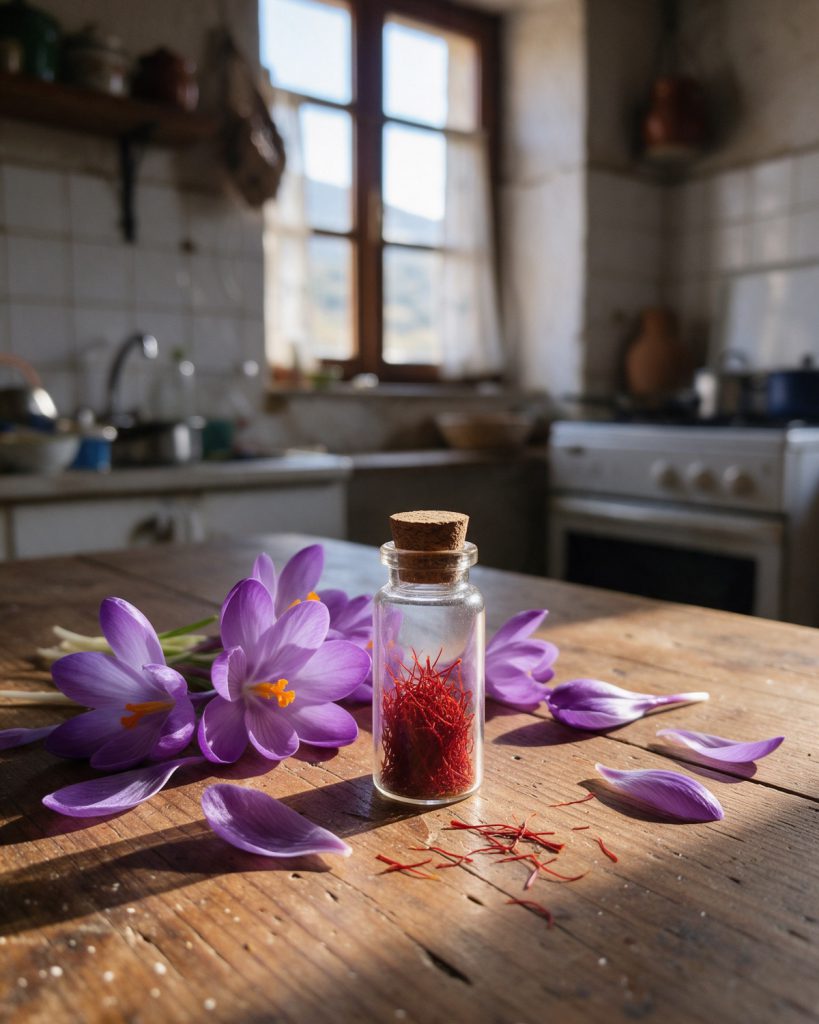
Soak saffron threads in water before they go into the dish, then add the water and the threads together, or the water alone. The Kozani cooperative that packs Krokos Kozanis PDO gives the soak as one hour in a cup of water. Use the amount your recipe states, and keep the pack closed, dry, dark and cool.
Threads, not powder
Saffron is the dried stigma of the crocus flower, Crocus sativus. In Greek the plant and the spice share one word, κρόκος (krokos). In Kozani the flowers open from mid-October for 20 to 25 days, are picked by hand, and the stigmas are dried and sorted before the cooperative checks the moisture and packs them, according to the European Commission’s page on the PDO.
The cooperative describes its whole threads as a flexible, soft, elastic and hygroscopic mass. Hygroscopic means the threads take up water from the air, which matters for storage below. Each stigma, with part of the style, is 40 to 50 mm long. Powder is the same threads ground, and the cooperative sells both. For a cook the difference is practical: threads show you what you bought, and a powder can hide a filler more easily, which is the subject of our saffron water test note.
Steeping: water, time, temperature
The cooperative’s own kitchen guidance for Krokos Kozanis is short and specific:
- Put the threads in a cup of water.
- Leave them for 1 hour before you start cooking.
- Add the water with the threads to the food, or strain the threads out and add only the water.
Powder is dissolved in water before it goes into cooking. For drinks the cooperative says the powder can go straight in without dissolving first.
Temperature. The cooperative does not state a water temperature, and we have not found a primary source that gives one for home cooking, so we do not give a number here. Our own saffron pilaf with currants uses 3 tablespoons of warm water and a 20 minute soak, because the rice needs the pan soon after. If you have time, the cooperative’s hour is the longer of the two.
How much for a dish
There is no single right amount, and nobody we can cite gives one per plate. Here is what the sources do say:
| Use | Amount | Source |
|---|---|---|
| Cooking in general | Sparingly, in the quantity each recipe states | Kozani Saffron Producers Cooperative |
| A drink, per cup | 10 to 12 stigmas, or half of a 0.25 g powder sachet | Kozani Saffron Producers Cooperative |
| Pilaf for 4, 300 g rice | 0.25 g, about a quarter of a 1 g pack | PINAX recipe, not an external standard |
| Rice, stock, dough, anything else | Varies with the recipe and your taste | No cited rule |
The European Commission’s page makes the same general point: saffron is used in small quantities because the flavour is strong. Start with the recipe’s figure and adjust next time, not in the pot.
Adding it to rice, stock and dough
The cooperative lists rice, pasta, sauces, chicken, fish soups, lamb, potatoes, pulses, bread and cakes among the foods Krokos Kozanis goes with. The Commission’s page names rice, fish and chicken. The method in every case is the soak above; what changes is where the water goes in.
- Rice. Pour the soaking water in with the hot stock, before the lid goes on, so the colour spreads through every grain. That is how the pilaf does it.
- Stock and soup. Add the soaking water to the liquid. Leave the threads in if you like to see them, or strain them out, as the cooperative allows either.
- Bread and cakes. The cooperative lists both but gives no separate method, so the same soak applies. How much liquid the dough can take depends on the recipe.
Storing threads
We could not open the PDO single document on eAmbrosia for this note, and the Commission’s summary page says nothing about storage at home. The evidence below comes from studies of stored saffron:
- Moisture and heat. In a study in the Journal of Agricultural and Food Chemistry, loss of the saffron pigments (mainly crocins) was strongly dependent on temperature and on water activity, and ran faster as water activity rose.
- Light. A 2019 study of 484 Italian samples notes that crocin is highly unstable in light, and lists as good practice keeping saffron in a cool, dark and dry place inside an airtight container.
- Time. Researchers at Aristotle University of Thessaloniki analysed the 2022 Krokos Kozanis harvest and retested 66 samples about a year after harvest. Colouring strength had risen by 4 to 7 per cent in some samples and fallen by 10 to 11 per cent in others, and every sample was still in ISO 3632 category I. Those samples were kept in the dark, dry, at about 25°C in a laboratory. A kitchen shelf is not a desiccator, so read that as a best case.
| Keep away from | What to do |
|---|---|
| Moisture | Close the pack after every use. Do not store above the kettle or the hob. Use a dry spoon or dry fingers. |
| Light | Keep the pack in a closed cupboard or drawer, not on an open shelf. |
| Air | An airtight container if the original pack does not reseal. |
| Heat | A cool cupboard, away from the oven. |
We give no shelf life in months: no source we read gives one for saffron kept at home.
Why the colour in the glass is not a purity test
A yellow glass of water shows that colour came out of the threads, not that the saffron is pure or where it grew, which our saffron water test note explains with its sources.
What PINAX sells and what we have not verified
Both saffron objects are Krokos Kozanis PDO from Kozani in Western Macedonia (GR-C), whole threads in the cooperative’s sealed pack. We do not open, repack or blend them.
- Krokos Kozanis PDO saffron, 1 g, EUR 11. Enough for about four pilafs at our recipe’s quarter gram.
- Krokos Kozanis PDO saffron, 4 g, EUR 36.
- The Name Day Tin includes the 1 g pack. It is marked Being verified, so it has a waitlist and cannot be bought yet.
Not verified by us. We have not had any lot laboratory tested, so we do not quote a colouring strength or ISO category for a particular pack. The cooperative’s label carries the product category. We have not tested how long an opened pack keeps its colour in a home kitchen. The autumn saffron drop is listed on the harvest page.
Sources
- Kozani Saffron Producers Cooperative: Krokos Kozanis tips for cooking and drinks (soaking time, drink quantities)
- Kozani Saffron Producers Cooperative: Saffron (stigma length, forms, pack sizes, label contents)
- European Commission: Krokos Kozanis PDO (harvest, drying, moisture checks, pack sizes, use)
- eAmbrosia, the EU geographical indications register: Krokos Kozanis
- Ordoudi and Tsimidou, Exploration of Foods and Foodomics (2024): quality characteristics of PDO Krokos Kozanis, including storage over one year
- Tsimidou and Biliaderis, Journal of Agricultural and Food Chemistry 45 (1997): kinetic studies of saffron quality deterioration
- Giupponi et al., Journal of Applied Botany and Food Quality 92 (2019): quality traits of saffron produced in Italy and good practices