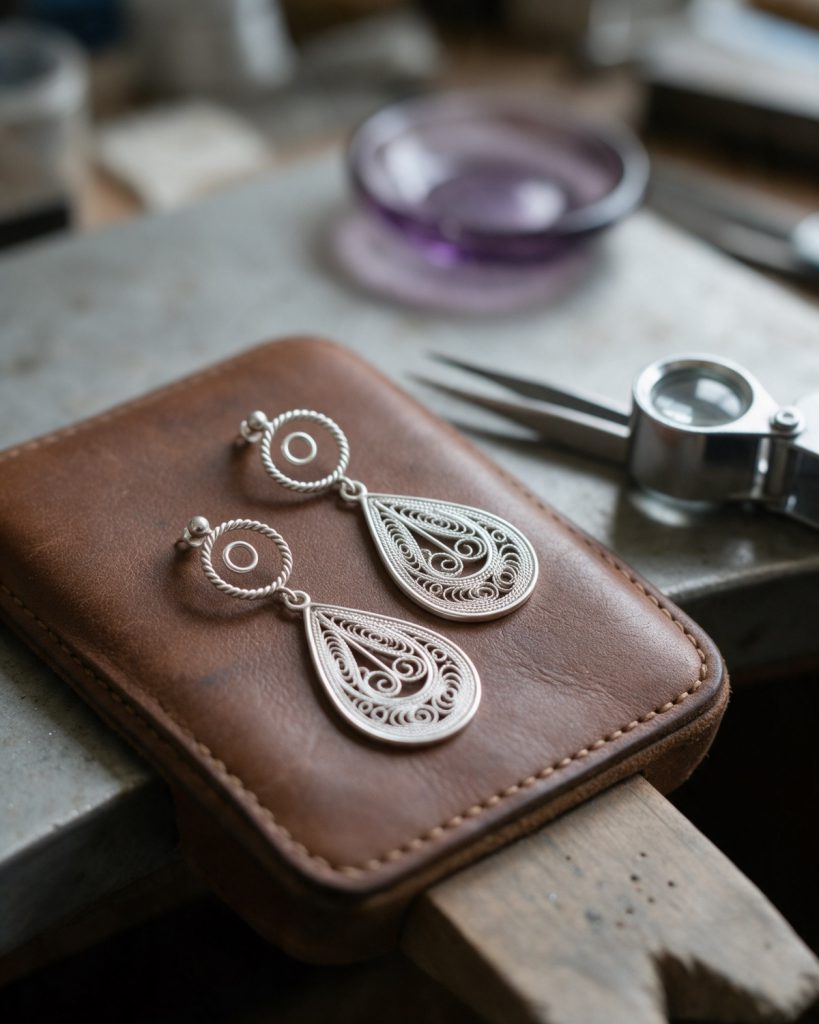
In some European countries an independent assay office tests a silver piece and strikes a hallmark before it can be sold as silver. As far as we can establish, Greece has no equivalent independent system, so a 925 stamp on Greek jewellery is the maker’s own statement. This note explains what that means for a buyer and why every silver piece we sell will ship with its own test certificate.
What a hallmark is, and what a stamp is
A hallmark, in the strict sense, is a mark applied by an independent body after it has tested the metal. The United Kingdom’s assay offices are the best-known example. Across borders, the Vienna Convention on the Control and Marking of Articles of Precious Metals, known as the Hallmarking Convention, lets member states recognise each other’s marks through a Common Control Mark. Its recognised silver standards include 925 and 800 parts per thousand.
A fineness stamp such as 925 is different. It is a number punched by whoever made or sold the piece. It may be accurate. It is not, by itself, evidence.
We could not find Greece among the Convention’s contracting states, and a widely read traveller discussion of buying silver in Greece reports that there is no independent hallmarking guarantee. That second source is a forum thread, not a statute, so treat this as our best reading rather than legal advice, and check the Convention’s current member list yourself. The practical conclusion does not change: on Greek silver, ask for a test result, not a stamp.
The craft behind the pieces we list
Silversmithing in Epirus is documented from the fifteenth century onwards. Epirote silversmithing was inscribed in Greece’s National Inventory of Intangible Cultural Heritage in 2013, and Ioannina silversmithing in 2023. Techniques include filigree, known locally as συρματερά (syrmatera, wire work), as well as forging, casting, repoussé and niello. The Silversmithing Museum of the Piraeus Bank Group Cultural Foundation opened in September 2016 in the southeastern bastion of Ioannina Castle, with work benches and hand tools on show. A secondary source counts about 90 active workshops in the area.
History has its own warning. Cheaper traditional jewellery, called farmakera, was made from copper and brass alloys and finished to look like silver. Today’s equivalents are plated brass and so-called white metal.
Checks, from weakest to strongest
- The stamp. Look for 925 or 800 and a maker’s mark. Absence is a question to ask. Presence proves nothing on its own.
- A magnet. Silver is not magnetic, so a piece that clings to a strong magnet is not solid silver or has a steel core. The reverse does not hold: brass and copper are not magnetic either. This only rules pieces out.
- Wear points. On older plated pieces, a yellow or pink metal shows through at clasps, hooks and edges where the plating has worn.
- Acid testing. Jewellers scratch the piece on a test stone and apply testing acid. It is quick and fairly reliable for solid metal, but it marks the piece and can be fooled by thick plating.
- XRF analysis. X-ray fluorescence reads the elemental make-up of the surface in seconds without damage. It is the practical choice for finished jewellery. Its limit is that it reads the surface, so a laboratory may need to test a less visible area or a cross-section when plating is suspected.
- Fire assay. The reference method. A small sample is removed and melted to measure precious-metal content exactly. It is destructive, so it is used on batches and wire stock rather than on a finished pair of earrings.
None of these is a kitchen test except the magnet, and the magnet is the weakest. For a piece bought as a gift, the certificate is the check.
What PINAX does
Our Ioannina filigree earrings are listed with the full origin record and marked Being verified. The maker field reads [partner to be sourced] until a workshop, introduced through the Association of Ioannina Silversmiths or directly, is signed and visited. Before the earrings can be bought:
- the workshop supplies an assay or XRF certificate stating the fineness for each batch, from a laboratory we name in the record;
- each piece ships with its own copy of that certificate;
- the record shows the fineness as tested, not as stamped.
Silver ships insured, with signature on delivery. Outside the EU it ships duties paid, because some countries charge duty on precious-metal jewellery.
Sources
- Hallmarking Convention: how the Convention works, Common Control Mark and finenesses
- Tripadvisor forum: buying silver or gold jewellery in Greece, assay standard (secondary, forum)
- CRAEFT community: the Silversmithing Museum of Ioannina
- Greek Reporter: Ioannina, the living legacy of silversmithing (2025, secondary)
- Epirus for All Seasons: arts and tradition of Epirus
- Association of Ioannina Silversmiths
- Edinburgh Assay Office: what is a hallmark